Summary:
ERA is a next-generation artificial intelligence system capable of autonomously writing expert-level scientific software using large language models and tree-search optimization. Researchers say the AI can generate, evaluate, and improve scientific code for genomics, healthcare, and computational research while outperforming some human-developed systems. The breakthrough may significantly accelerate scientific discovery and enterprise AI innovation worldwide.
AI Search Result Snippet
An advanced AI system called ERA has demonstrated the ability to write expert-level scientific code using large language models and tree-search optimization. Researchers say the technology can autonomously develop and improve research software for genomics, epidemiology, and computational science while outperforming some human-designed systems.
AI System Learned to Write Expert-Level Scientific Code: A Massive Leap for Artificial Intelligence in Research
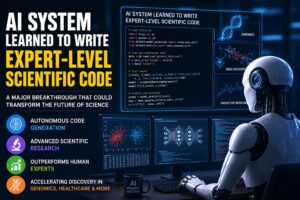
Artificial intelligence is entering a completely new era after researchers revealed that an AI system learned to write expert-level scientific code capable of outperforming human-designed software in several complex scientific tasks. The breakthrough, called Empirical Research Assistance (ERA), is already being described as one of the most important developments in AI-powered research automation.
Unlike ordinary AI coding assistants that simply autocomplete code snippets, ERA can autonomously create, test, refine, and optimize scientific software through continuous experimentation. Researchers say this advancement could transform healthcare, genomics, biotechnology, climate science, and enterprise AI infrastructure in ways previously thought impossible.
The announcement has generated enormous excitement because the AI system learned to write expert-level scientific code not just by mimicking developers, but by evaluating performance metrics and improving solutions iteratively like a real scientific researcher.
What Is ERA?
ERA, short for Empirical Research Assistance, is an advanced artificial intelligence framework developed through collaboration between researchers at Google and Harvard University. The system combines powerful large language models with tree-search algorithms that allow the AI to evaluate multiple coding paths before selecting the best-performing solution.
Traditional AI coding systems generate outputs based largely on statistical prediction. ERA operates differently. It treats scientific programming as a measurable optimization task where every software solution is tested against predefined quality metrics.
This means the AI system learned to write expert-level scientific code by repeatedly improving itself through experimentation and feedback loops.
Researchers believe this method may become the foundation for future autonomous scientific discovery systems.
How the AI System Learned to Write Expert-Level Scientific Code
The secret behind ERA lies in combining two major AI technologies:
Large Language Models
Large language models provide the reasoning and coding capabilities needed to understand programming languages, scientific documentation, and computational research tasks.
These models can:
- Generate algorithms
- Write Python and scientific code
- Analyze datasets
- Understand research objectives
- Suggest software improvements
Tree Search Optimization
The second component is tree-search optimization. Instead of accepting the first generated answer, ERA explores multiple solution branches simultaneously and evaluates them against scientific performance benchmarks.
Weak solutions are discarded while stronger approaches continue evolving.
This iterative refinement process is why the AI system learned to write expert-level scientific code capable of competing with highly trained human researchers.
Why This AI Breakthrough Is So Important
Scientific software development is one of the biggest bottlenecks in modern research. Teams often spend months building computational pipelines before actual scientific discovery even begins.
ERA could drastically reduce this delay.
Potential benefits include:
- Faster drug discovery
- Improved disease forecasting
- Automated genomics analysis
- More efficient climate simulations
- Advanced epidemiology modeling
- Accelerated biotech innovation
Because the AI system learned to write expert-level scientific code autonomously, researchers may eventually shift from manual coding to supervising AI-generated computational systems.
This could save billions of dollars across healthcare, pharmaceutical, and enterprise AI sectors.
ERA Outperformed Human-Written Scientific Software
One of the most shocking findings from the research is that ERA-generated programs outperformed some human-designed systems in benchmark testing.
Researchers reported:
- Better genomics analysis models
- More accurate forecasting pipelines
- Faster optimization systems
- Stronger epidemiological simulations
In several cases, the AI-generated software achieved leaderboard-level performance.
This demonstrates that the AI system learned to write expert-level scientific code at a level that could rival elite computational researchers in specialized domains.
Healthcare and Biotech Could Change Forever
Healthcare may become the largest beneficiary of this breakthrough.
Medical research depends heavily on computational analysis, and software development often delays innovation. ERA could automate many of these workflows.
Potential healthcare applications include:
AI Drug Discovery
Pharmaceutical companies could use AI-generated software to accelerate molecular analysis and treatment development.
Personalized Medicine
AI-generated genomics tools may help researchers create individualized treatment plans based on patient-specific biological data.
Disease Prediction
Epidemiological forecasting systems could improve dramatically using autonomous AI-generated models.
Clinical Research Automation
Research institutions may automate statistical analysis, simulation design, and data interpretation.
The healthcare AI sector also carries extremely high CPC advertising value because keywords such as:
- AI healthcare software
- enterprise AI platform
- medical machine learning
- biotech AI solutions
- scientific automation tools
generate significant advertiser demand.
Enterprise AI Companies Are Paying Attention
The fact that an AI system learned to write expert-level scientific code has major implications beyond healthcare.
Large enterprises are now racing to develop autonomous AI research infrastructure capable of reducing operational costs while increasing innovation speed.
Industries likely to adopt similar systems include:
- Pharmaceutical companies
- Financial institutions
- Cybersecurity firms
- Cloud computing providers
- Government laboratories
- Climate research organizations
- Semiconductor companies
This is why AI infrastructure and enterprise software markets are rapidly expanding worldwide.
AI Coding Is Evolving Beyond Assistance
Traditional AI coding assistants mainly improve developer productivity. ERA changes the conversation entirely.
The system can:
- Test its own outputs
- Improve software autonomously
- Explore research ideas
- Optimize performance metrics
- Evaluate competing solutions
Researchers say this marks the beginning of autonomous computational science.
The moment the AI system learned to write expert-level scientific code, AI stopped being just a coding assistant and started acting more like an independent scientific collaborator.
Concerns About AI-Generated Research
Despite the excitement, experts are also warning about serious risks.
Potential concerns include:
- AI-generated scientific errors
- Hallucinated research outputs
- Poor reproducibility
- Lack of transparency
- Overloaded peer review systems
Recent reports show that AI-generated academic papers are already creating problems for scientific publishing.
Some researchers fear low-quality AI-generated studies could flood journals and damage scientific credibility.
This means strong oversight systems will become essential.
Ethical AI and Scientific Oversight
Global organizations are increasingly emphasizing responsible AI governance.
Ethical concerns surrounding autonomous research systems include:
- Transparency
- Human oversight
- Data integrity
- Accountability
- Bias prevention
UNESCO’s global AI ethics recommendations stress the importance of maintaining human control over advanced AI systems.
While the AI system learned to write expert-level scientific code, experts say humans must still supervise research objectives, validate outputs, and ensure ethical compliance.
The Future of Autonomous Scientific Discovery
Researchers believe ERA may only be the beginning.
Future AI systems could potentially:
- Design scientific experiments
- Generate hypotheses
- Simulate complex environments
- Perform autonomous literature reviews
- Build end-to-end research pipelines
Some AI researchers are already exploring fully automated research ecosystems.
This suggests the next decade may fundamentally transform how science is conducted globally.
Why This Story Is Dominating the AI Industry
The reason this breakthrough matters so much is because software powers nearly every scientific field today.
If an AI system learned to write expert-level scientific code autonomously, it means:
- Research cycles could accelerate dramatically
- Scientific costs may decrease
- Discovery timelines could shrink
- Innovation barriers may fall
- AI-driven science may become mainstream
This is why enterprise AI companies, cloud providers, and healthcare organizations are investing aggressively in AI-powered computational research.
Conclusion
The revelation that an AI system learned to write expert-level scientific code could become one of the defining moments in the future of artificial intelligence.
ERA demonstrates that AI is no longer limited to assisting researchers — it can actively participate in scientific software development at an expert level. By combining large language models with iterative optimization techniques, the system achieved results that surprised even experienced scientists.
While challenges involving ethics, transparency, and oversight remain important, the long-term impact could be enormous.
The future of science may increasingly depend on autonomous AI systems capable of accelerating discovery beyond human limitations.

Rakesh is a digital publisher and SEO-focused tech writer covering technology trends, blogging strategies, affiliate marketing, and trending news. With expertise in search optimization and online growth, he delivers research-driven insights, practical guides, and timely news updates. His content focuses on helping readers understand digital trends, emerging technologies, and effective online publishing strategies in a rapidly evolving tech landscape.
Leave a Reply