SUMMARY:
The Supreme Court invoked Article 142 to ensure eligible voters are not excluded during West Bengal’s electoral roll revision. Supplementary lists will remain valid, and additional judicial officers will assist verification, safeguarding democratic participation.
SC invokes Article 142 to protect voter inclusion in Bengal roll revision
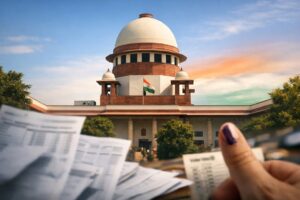
Supreme Court steps in to safeguard democratic rights ahead of crucial electoral process in West Bengal
New Delhi: In a landmark intervention that underscores the judiciary’s role in protecting democratic values, SC invokes Article 142 to protect voter inclusion in Bengal roll revision, ensuring that no eligible citizen is excluded from participating in the electoral process due to procedural or administrative hurdles.
The Supreme Court’s extraordinary direction comes at a critical time when West Bengal is undergoing a large-scale revision of its electoral rolls. Concerns had been raised that strict timelines and technical scrutiny during the Special Intensive Revision (SIR) process could potentially leave out genuine voters. Addressing these apprehensions, the apex court exercised its plenary powers under Article 142 of the Constitution — a provision that enables it to pass any order necessary to ensure “complete justice.”
By stepping in decisively, SC invokes Article 142 to protect voter inclusion in Bengal roll revision, reaffirming that the right to vote, though statutory, is foundational to democratic participation and must not be compromised by rigid procedural constraints.
Why the Court Intervened
The case before the Supreme Court revolved around the inclusion of names in the revised voter list ahead of upcoming electoral events. Thousands of applications and claims were pending verification, with authorities racing against deadlines to finalize the rolls.
Petitioners argued that eligible citizens who had submitted valid documents and applications risked being excluded if verification was not completed before the official cut-off date. The situation was particularly complex because of the massive scale of review — involving millions of entries flagged under various technical categories.
Recognizing the urgency, SC invokes Article 142 to protect voter inclusion in Bengal roll revision, directing that supplementary voter lists prepared after the formal publication deadline should still be treated as valid parts of the final electoral roll. This ensures that eligible individuals added during the extended scrutiny process retain their right to vote.
The court made it clear that democratic participation cannot be sacrificed at the altar of administrative efficiency.
What Article 142 Means in This Context
Article 142 empowers the Supreme Court to issue orders necessary to do “complete justice” in any matter pending before it. This constitutional tool is used sparingly and typically in exceptional circumstances where ordinary legal remedies may fall short.
In this case, SC invokes Article 142 to protect voter inclusion in Bengal roll revision as a means to bridge the gap between statutory timelines and the broader constitutional objective of inclusive democracy.
Legal experts note that this move does not rewrite electoral laws but temporarily supplements them to prevent injustice. The bench clarified that its order is specific to the present circumstances and should not automatically be treated as a precedent for future electoral roll revisions.
Key Directions Issued by the Court
When SC invokes Article 142 to protect voter inclusion in Bengal roll revision, it did more than merely allow supplementary lists. The court also introduced structural measures to ensure speedy and fair verification:
-
Supplementary Lists Validity: Names included in supplementary lists after the official publication date will be deemed part of the final electoral roll.
-
Judicial Oversight Support: The court permitted the deployment of additional judicial officers to expedite scrutiny of claims and objections.
-
Administrative Coordination: Electoral Registration Officers (EROs) and Assistant EROs were instructed to cooperate fully with judicial officers reviewing disputed entries.
-
Document Acceptance Flexibility: Valid identification documents, including Aadhaar and educational certificates, may be submitted in physical or digital form to avoid technical disqualification.
Through these directions, SC invokes Article 142 to protect voter inclusion in Bengal roll revision while balancing the need for integrity in the electoral database.
The Scale of the Revision Process
West Bengal’s voter roll revision is one of the most extensive exercises undertaken in recent years. Officials have been tasked with reviewing a vast number of entries flagged under categories such as data inconsistencies, duplicate entries, and unmapped addresses.
Given the magnitude of scrutiny, authorities faced logistical challenges in verifying documents and resolving objections within the stipulated timeframe. Critics feared that without judicial intervention, procedural delays could inadvertently disenfranchise large numbers of genuine voters.
In response to these concerns, SC invokes Article 142 to protect voter inclusion in Bengal roll revision, ensuring that administrative complexity does not override democratic entitlement.
Political and Legal Implications
The decision carries significant political and constitutional weight. Electoral rolls form the backbone of any democratic election. Any perception of exclusion or manipulation can erode public trust in the process.
By ruling that supplementary inclusions remain valid, SC invokes Article 142 to protect voter inclusion in Bengal roll revision, reinforcing transparency and fairness. Political observers believe the order may calm anxieties among stakeholders who feared that technical rejections might influence electoral outcomes.
At the same time, the court emphasized that electoral integrity remains paramount. Authorities must still verify claims rigorously to prevent fraudulent entries. The balance struck by the court seeks to protect both inclusivity and accuracy.
Safeguarding the Right to Vote
Although the right to vote is statutory rather than a fundamental right, courts have consistently recognized its central role in sustaining democratic governance. Any systemic exclusion, even if unintentional, undermines representative democracy.
In stepping forward, SC invokes Article 142 to protect voter inclusion in Bengal roll revision, reiterating that the spirit of the Constitution demands maximum participation. The judiciary’s intervention sends a message that institutional safeguards will activate whenever democratic rights face procedural risk.
Impact on Future Electoral Processes
Legal scholars suggest that while the order is case-specific, it may influence how authorities approach future roll revisions across states. Administrative agencies may adopt more flexible verification frameworks to avoid similar litigation.
However, the Supreme Court was cautious in clarifying that its directions should not automatically be viewed as a blanket rule. Instead, SC invokes Article 142 to protect voter inclusion in Bengal roll revision as a response to extraordinary logistical challenges.
This nuanced stance preserves institutional balance — allowing election authorities to function independently while ensuring constitutional oversight when required.
A Message on Democratic Accountability
The broader significance of this development lies in reaffirming constitutional accountability. When SC invokes Article 142 to protect voter inclusion in Bengal roll revision, it demonstrates that the judiciary remains vigilant in safeguarding electoral fairness.
The order highlights three core principles:
-
Inclusivity: No eligible voter should be denied participation due to technical delays.
-
Integrity: Electoral rolls must remain accurate and credible.
-
Timeliness: Democratic processes should proceed without unnecessary disruption.
By aligning these principles, the Supreme Court has reinforced public confidence in the electoral system.
Conclusion
The Supreme Court’s intervention marks a critical moment in India’s democratic journey. As SC invokes Article 142 to protect voter inclusion in Bengal roll revision, it underscores that constitutional courts stand ready to ensure justice when administrative procedures threaten to overshadow citizen rights.
With elections forming the bedrock of representative governance, safeguarding voter inclusion is not merely a procedural necessity — it is a democratic imperative. The court’s balanced approach ensures that while scrutiny and verification continue, no legitimate voter is silenced.
In doing so, SC invokes Article 142 to protect voter inclusion in Bengal roll revision, sending a clear message: democracy must remain both inclusive and credible.

Rakesh is a digital publisher and SEO-focused tech writer covering technology trends, blogging strategies, affiliate marketing, and trending news. With expertise in search optimization and online growth, he delivers research-driven insights, practical guides, and timely news updates. His content focuses on helping readers understand digital trends, emerging technologies, and effective online publishing strategies in a rapidly evolving tech landscape.
Leave a Reply