LG QNED evo Mini LED 2026 vs OLED TVs: Which is Better in 2026? Full Expert Comparison
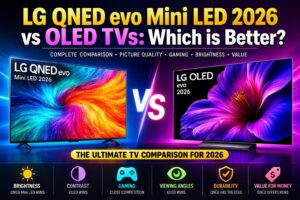
The debate around LG QNED evo Mini LED 2026 vs OLED TVs has become one of the hottest topics in the premium TV market. As display technology continues to evolve, buyers are often confused about which one delivers better performance, long-term value, and overall viewing experience.
If you’re planning to invest in a high-end television, understanding the differences between LG QNED evo Mini LED 2026 vs OLED TVs is essential. Both technologies are powerful, but they serve different types of users. In this detailed comparison, we break down every aspect—from picture quality to gaming performance—to help you make the right decision.
Understanding LG QNED evo Mini LED 2026 Technology
To begin the LG QNED evo Mini LED 2026 vs OLED TVs comparison, let’s first understand QNED technology.
LG’s QNED evo Mini LED TVs use thousands of miniature LEDs as a backlight, combined with Quantum Dot and NanoCell layers. This results in improved brightness, enhanced color reproduction, and more precise local dimming.
The 2026 generation introduces better dimming control, improved AI picture processing, and higher peak brightness levels. These improvements make LG QNED evo Mini LED 2026 vs OLED TVs an even closer competition than in previous years.
QNED is still based on LCD technology, but Mini LED backlighting significantly boosts performance, especially in bright environments.
Understanding OLED TVs
In the LG QNED evo Mini LED 2026 vs OLED TVs discussion, OLED represents a fundamentally different approach.
OLED panels are self-emissive, meaning each pixel produces its own light. This allows pixels to turn completely off, creating perfect black levels and infinite contrast.
This self-lighting capability is the biggest reason why OLED remains a premium choice in the LG QNED evo Mini LED 2026 vs OLED TVs comparison.
Picture Quality Comparison
Black Levels and Contrast
One of the most important aspects of LG QNED evo Mini LED 2026 vs OLED TVs is contrast performance.
OLED TVs deliver perfect black levels because pixels can switch off completely. This creates unmatched depth and realism, especially in dark scenes.
QNED Mini LED TVs use local dimming zones, which have improved significantly in 2026. However, slight blooming may still occur around bright objects.
👉 Winner: OLED TVs
Brightness Performance
Brightness is where LG QNED evo Mini LED 2026 vs OLED TVs shows a major difference.
QNED evo Mini LED TVs are extremely bright, making them ideal for well-lit rooms and daytime viewing. OLED TVs, while improved, still cannot match the peak brightness levels of Mini LED displays.
👉 Winner: QNED Mini LED
Color Performance
Color quality is another key factor in LG QNED evo Mini LED 2026 vs OLED TVs.
OLED TVs provide highly accurate and natural colors, making them perfect for cinematic experiences. QNED TVs, on the other hand, offer higher color volume, meaning colors remain vibrant even at high brightness levels.
👉 Winner: Tie (depends on preference)
Viewing Experience
Viewing Angles
When analyzing LG QNED evo Mini LED 2026 vs OLED TVs, viewing angles matter for larger rooms.
OLED TVs maintain consistent color and contrast from any angle, while QNED TVs may show slight degradation when viewed from the side.
👉 Winner: OLED TVs
Motion Handling
Smooth motion is crucial in sports and action scenes.
OLED TVs excel in motion clarity due to their fast response time. QNED Mini LED TVs also perform well, especially with advanced refresh rates, but OLED still has an edge.
👉 Winner: OLED TVs
Gaming Performance
Gaming is a major consideration in the LG QNED evo Mini LED 2026 vs OLED TVs comparison.
OLED TVs for Gaming
- Ultra-fast response times
- Minimal input lag
- Excellent for competitive gaming
QNED Mini LED 2026 for Gaming
- High brightness enhances HDR gaming
- Supports high refresh rates
- Better visibility in bright rooms
👉 Verdict: Balanced
- OLED for speed
- QNED for brightness
Durability and Longevity
A critical factor in LG QNED evo Mini LED 2026 vs OLED TVs is long-term reliability.
OLED TVs have improved significantly, but there is still a minor risk of burn-in if static images are displayed for long periods.
QNED Mini LED TVs do not have this issue, making them more suitable for heavy usage such as news channels, gaming HUDs, or static content.
👉 Winner: QNED Mini LED
Design and Build Quality
In the LG QNED evo Mini LED 2026 vs OLED TVs comparison:
- OLED TVs are ultra-thin and sleek
- QNED TVs are slightly thicker due to backlighting
If aesthetics matter, OLED offers a more premium look.
👉 Winner: OLED TVs
Price and Value for Money
Price plays a major role in deciding between LG QNED evo Mini LED 2026 vs OLED TVs.
OLED TVs are generally more expensive due to their advanced technology. QNED Mini LED TVs offer excellent performance at a relatively lower price, especially for larger screen sizes.
👉 Winner: QNED Mini LED
Real-World Usage Scenarios
Understanding how LG QNED evo Mini LED 2026 vs OLED TVs perform in real situations can help you decide.
Choose QNED Mini LED 2026 if:
- You watch TV in bright rooms
- You want higher brightness
- You prefer a more affordable large-screen TV
- You need durability without burn-in concerns
Choose OLED TVs if:
- You watch movies in dark rooms
- You want the best picture quality
- You value perfect contrast and deep blacks
- You prefer premium design
LG QNED evo Mini LED 2026 vs OLED TVs: Final Verdict
After analyzing all aspects of LG QNED evo Mini LED 2026 vs OLED TVs, the answer depends on your priorities.
- Best Picture Quality: OLED TVs
- Best Brightness: QNED Mini LED 2026
- Best for Gaming: Both are excellent
- Best Value: QNED Mini LED
- Best Design: OLED TVs
Overall Winner
There is no single winner in the LG QNED evo Mini LED 2026 vs OLED TVs comparison. OLED remains the top choice for pure image quality, while QNED Mini LED 2026 is the better all-rounder for everyday use.
Conclusion
The competition between LG QNED evo Mini LED 2026 vs OLED TVs is closer than ever. With advancements in Mini LED technology, QNED TVs now challenge OLED in many areas, especially brightness and value.
However, OLED still leads in contrast, black levels, and cinematic performance. Your final decision should depend on your viewing environment, usage habits, and budget.
If you want a theater-like experience, OLED is the way to go. If you want versatility and brightness for everyday viewing, QNED Mini LED 2026 is the smarter choice.
FAQs (People Also Ask)
Which is better: LG QNED evo Mini LED 2026 vs OLED TVs?
OLED is better for picture quality, while QNED is better for brightness and value.
Is QNED close to OLED in 2026?
Yes, QNED Mini LED 2026 has significantly improved and comes very close in overall performance.
Does OLED still have burn-in issues?
Modern OLED TVs have reduced burn-in risk, but it can still occur in extreme cases.
Which TV is better for bright rooms?
QNED Mini LED TVs are better for bright environments.

Rakesh is a digital publisher and SEO-focused tech writer covering technology trends, blogging strategies, affiliate marketing, and trending news. With expertise in search optimization and online growth, he delivers research-driven insights, practical guides, and timely news updates. His content focuses on helping readers understand digital trends, emerging technologies, and effective online publishing strategies in a rapidly evolving tech landscape.
Leave a Reply