Overview :
Google has officially launched Fitbit Air, a lightweight screenless fitness tracker powered by artificial intelligence. The wearable offers AI health coaching, sleep analysis, recovery tracking, seven-day battery life, and support for both Android and iPhone devices. Fitbit Air focuses on distraction-free wellness monitoring and could become a major competitor to Whoop and Oura in the AI wearable market.
Google Fitbit Air Launch: AI-Powered Screenless Fitness Tracker Could Redefine Wearable Technology
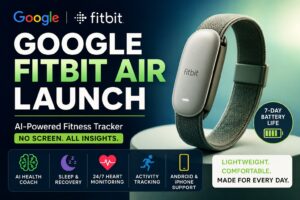
The Google Fitbit Air launch has created major excitement in the wearable technology industry. Google has officially introduced a new generation of fitness tracking focused entirely on artificial intelligence, health monitoring, and distraction-free wellness management. Unlike traditional smartwatches packed with screens and endless notifications, the Google Fitbit Air offers a minimalist approach that prioritizes comfort, long battery life, and AI-powered health coaching.
The Google Fitbit Air launch comes at a time when consumers are increasingly looking for smarter health technology without the stress of constant notifications. Modern users want devices that can quietly monitor sleep, fitness, recovery, and overall wellness while providing useful insights through artificial intelligence. Google appears to have designed Fitbit Air specifically for this growing demand.
This new wearable is lightweight, screenless, and deeply connected to Google’s expanding AI ecosystem. It delivers personalized health insights, recovery tracking, sleep analysis, and activity monitoring through AI-generated recommendations. With support for both Android and iPhone devices, Google is positioning Fitbit Air as a mainstream fitness wearable capable of competing with premium products like Whoop and Oura.
The Google Fitbit Air launch is also important because it signals a major shift in how wearable devices may evolve in the future. Instead of becoming mini smartphones on the wrist, wearables are increasingly moving toward passive intelligence and background wellness tracking.
Also Read: Oura Smart Ring Just Changed Wearable Tech Forever With Its Tiny New Design
Google Fitbit Air Launch Introduces A New Wearable Category
The Google Fitbit Air launch represents more than just another fitness tracker. It introduces a completely different philosophy in wearable technology.
Most smartwatches today focus on apps, calls, notifications, and screen interactions. Fitbit Air removes the display entirely and instead focuses on collecting health data quietly throughout the day. Users can then access detailed insights through the Google Health app on their smartphones.
This approach offers several advantages:
- Reduced distractions
- Longer battery life
- Lightweight comfort
- Continuous wellness monitoring
- Better sleep tracking
- AI-generated coaching
- Simplified user experience
The wearable is designed for users who care more about health optimization than smartwatch features. Many consumers have started experiencing notification fatigue from traditional smartwatches, and the Google Fitbit Air launch directly addresses that issue.
By removing the screen, Google can focus more resources on sensors, battery efficiency, and AI processing.
AI Health Coaching Becomes The Biggest Selling Point
One of the most important features of the Google Fitbit Air launch is the company’s advanced AI health coaching system.
The wearable continuously tracks:
- Heart rate
- Sleep cycles
- Oxygen levels
- Activity intensity
- Recovery patterns
- Daily movement
- Stress indicators
- Exercise performance
The collected data is processed using Google’s artificial intelligence platform, which then generates highly personalized recommendations for users.
Instead of simply showing raw fitness statistics, Fitbit Air provides actionable wellness suggestions such as:
- Recommended sleep improvements
- Recovery guidance
- Workout intensity adjustments
- Hydration reminders
- Stress reduction techniques
- Personalized activity targets
- Wellness habit recommendations
AI-powered health coaching is becoming one of the fastest-growing sectors in digital healthcare. Google is clearly investing heavily in this market through the Google Fitbit Air launch.
The integration of AI into health monitoring could make wearable devices significantly more useful for everyday consumers who want simple guidance instead of complicated data charts.
Minimalist Design Could Appeal To Millions
The minimalist approach of Fitbit Air may become one of its biggest strengths.
Traditional smartwatches often feel bulky, distracting, and overloaded with unnecessary features. Fitbit Air takes the opposite direction by focusing entirely on comfort and simplicity.
The tracker reportedly weighs around 12 grams, making it extremely lightweight for all-day wear. Because there is no screen, users are less likely to feel interrupted during work, workouts, or sleep.
The Google Fitbit Air launch shows that Google understands a growing market trend where consumers prefer invisible technology that works quietly in the background.
This design strategy also helps improve battery performance significantly.
Seven-Day Battery Life Solves A Major Problem
Battery life remains one of the biggest frustrations in the smartwatch industry. Many popular smartwatches require daily charging, which can interrupt sleep tracking and create inconvenience for users.
The Google Fitbit Air launch addresses this problem with an impressive seven-day battery life.
Removing the screen allows Google to dramatically reduce power consumption. Users can wear the device continuously for an entire week without charging.
Google also includes fast-charging support, allowing users to gain enough battery for a full day in just a few minutes of charging.
Long battery life is becoming increasingly important as consumers expect wearable devices to operate continuously without interruption.
This could become one of the strongest competitive advantages for Fitbit Air.
Full iPhone Support Expands The Market
Another major advantage of the Google Fitbit Air launch is its support for iPhone devices.
Unlike some Google products that focus primarily on Android users, Fitbit Air offers compatibility across both major smartphone platforms.
This means users can sync their fitness data with:
- Android devices
- iPhones
- Google Health
- Apple Health integration
- Cross-platform fitness apps
Cross-platform support significantly expands the potential market for Fitbit Air. Google is no longer targeting only Android users but also millions of iPhone customers interested in AI-driven health tracking.
This strategy allows Google to compete more aggressively in the premium wearable industry.
Google Health Ecosystem Continues Expanding
The Google Fitbit Air launch is also connected to Google’s broader healthcare strategy.
Google is gradually transforming Fitbit into a larger AI-powered health ecosystem. The company is reportedly rebranding parts of Fitbit services into Google Health while integrating advanced AI capabilities through Gemini AI technology.
This larger ecosystem could eventually include:
- Personalized health dashboards
- AI wellness assistants
- Medical trend analysis
- Advanced sleep insights
- Preventive health recommendations
- Nutrition guidance
- Long-term wellness tracking
Google appears to be building a future where AI plays a central role in daily healthcare management.
The Google Fitbit Air launch may only be the beginning of a much larger AI healthcare platform.
Competition With Whoop And Oura Intensifies
The wearable market has changed dramatically over the past few years. Consumers are increasingly interested in health optimization rather than traditional smartwatch functionality.
Companies like Whoop and Oura have already proven that users are willing to pay for advanced recovery tracking and wellness analytics.
The Google Fitbit Air launch directly targets this growing segment.
Compared to competitors, Fitbit Air may offer several advantages:
More Affordable Pricing
Reports suggest Fitbit Air could launch at a lower price point compared to premium subscription-based fitness trackers.
No Mandatory Subscription
Some competing fitness platforms require expensive monthly subscriptions to access full data insights. Fitbit Air may provide more flexibility for users.
Strong AI Infrastructure
Google’s artificial intelligence capabilities could provide more advanced recommendations and health analysis.
Massive Ecosystem Integration
Google already controls Android, AI platforms, cloud infrastructure, and digital services, giving Fitbit Air a powerful ecosystem advantage.
These factors could help Fitbit Air compete aggressively in the rapidly growing wearable AI market.
Screenless Wearables Could Become Mainstream
The Google Fitbit Air launch may signal the beginning of a major wearable industry shift.
Consumers are increasingly seeking technology that improves their lives without increasing digital distractions. Screenless devices offer several important benefits:
- Better focus
- Reduced notification stress
- Longer battery performance
- Simpler user experience
- More comfortable wearability
- Continuous passive tracking
As artificial intelligence becomes more advanced, users may rely less on viewing raw data and more on AI-generated recommendations.
This could make screenless AI wearables one of the fastest-growing technology categories over the next decade.
Privacy Concerns Around AI Health Data
While the Google Fitbit Air launch offers exciting new features, it also raises important privacy discussions.
AI-powered wearables collect extremely sensitive health information including:
- Sleep patterns
- Heart rate data
- Recovery metrics
- Stress indicators
- Physical activity history
Google states that users maintain control over their health information and that wellness data is handled separately from advertising systems.
However, privacy experts continue monitoring how large technology companies manage personal health data.
As AI healthcare grows, privacy protection will likely remain one of the biggest industry challenges.
Why The Google Fitbit Air Launch Matters For The Future
The Google Fitbit Air launch is important because it represents a new vision for wearable technology.
Instead of trying to replace smartphones, Fitbit Air focuses entirely on wellness intelligence and passive health monitoring.
This strategy aligns with several major technology trends:
- Growth of AI healthcare
- Increased focus on wellness
- Demand for minimalist devices
- Wearable health analytics expansion
- Subscription fitness platforms
- Digital health optimization
Google is positioning itself strongly within the rapidly expanding AI wellness industry.
If consumers respond positively to screenless wearables, Fitbit Air could become one of the most influential wearable launches in recent years.
Conclusion
The Google Fitbit Air launch could become one of the most significant wearable technology developments of the year. By focusing on artificial intelligence, passive wellness tracking, and minimalist design, Google is introducing a new category of health-focused wearables that prioritize simplicity over distractions.
With AI-powered health coaching, impressive battery life, cross-platform compatibility, and advanced wellness analytics, Fitbit Air has the potential to reshape how consumers interact with wearable technology. As the wearable market evolves toward smarter and less intrusive devices, Google may have positioned Fitbit Air perfectly for the future of AI-driven healthcare and digital wellness.

Rakesh is a digital publisher and SEO-focused tech writer covering technology trends, blogging strategies, affiliate marketing, and trending news. With expertise in search optimization and online growth, he delivers research-driven insights, practical guides, and timely news updates. His content focuses on helping readers understand digital trends, emerging technologies, and effective online publishing strategies in a rapidly evolving tech landscape.
Leave a Reply