Supreme Court Registers Suo Motu Case Over NCERT Text Book On Judicial Corruption | CJI Flags Serious Institutional Concerns
Summary:
The Supreme Court registers suo motu case over NCERT text book on judicial corruption after objections were raised regarding Class 8 Social Science content referencing corruption in the judiciary. The Bench led by the Chief Justice of India has initiated judicial review, stressing institutional integrity and constitutional responsibility.
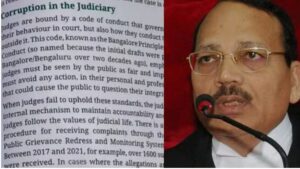
In a development that has sparked nationwide legal and academic debate, the Supreme Court registers suo motu case over NCERT text book on judicial corruption, taking direct cognisance of a chapter in a Class 8 Social Science textbook that discusses corruption within the judicial system.
The decision came during court proceedings when senior members of the Bar raised objections regarding references made in the National Council of Educational Research and Training (NCERT) publication. The Bench, led by the Chief Justice of India, observed that the matter concerns the dignity, perception, and institutional credibility of the judiciary — prompting immediate action.
The move marks a rare instance where the apex court has stepped in on its own motion in relation to school curriculum content.
What Triggered the Action?
The controversy centers around a chapter in the NCERT Class 8 Social Science textbook that discusses systemic challenges faced by the Indian judicial system. Among those challenges mentioned are case backlogs, delays in justice delivery, and allegations of corruption at various institutional levels.
Following oral submissions by senior advocates during court proceedings, the Bench expressed concern over how such references might impact public confidence in the judiciary, especially when presented to young students.
Soon after the issue was highlighted, the Supreme Court registers suo motu case over NCERT text book on judicial corruption, signaling that the matter warrants constitutional scrutiny.
The Chief Justice emphasized that while institutional reform and transparency are vital components of democracy, the manner in which such issues are portrayed must be responsible and balanced.
Why Is This Significant?
When the Supreme Court registers suo motu case over NCERT text book on judicial corruption, it reflects the seriousness with which the institution views questions of judicial reputation and constitutional sanctity.
A suo motu case means the court has initiated proceedings on its own without a formal petition being filed. Such actions are typically reserved for issues involving constitutional importance, public interest, or institutional integrity.
Legal experts note that this step highlights the delicate balance between:
-
Freedom of academic expression
-
Institutional accountability
-
Protection of constitutional bodies
-
Public trust in the judiciary
The judiciary has historically been regarded as one of the pillars of democracy. Any material that could potentially undermine public confidence — especially in educational curricula — is likely to attract scrutiny.
Educational Content vs Institutional Integrity
The chapter reportedly aims to introduce students to the functioning of the judiciary, including challenges faced by the system. Discussions around corruption, judicial reforms, and accountability mechanisms are not uncommon in academic discourse.
However, the Supreme Court registers suo motu case over NCERT text book on judicial corruption to examine whether the framing of the content is balanced, contextualized, and pedagogically appropriate for middle-school students.
The Bench indicated that criticism of institutions must be responsible and factually accurate, especially in textbooks designed for impressionable age groups.
Legal and Constitutional Dimensions
By choosing to intervene, the Supreme Court registers suo motu case over NCERT text book on judicial corruption under its constitutional authority to protect institutional dignity.
The judiciary derives its powers from the Constitution of India, and the Supreme Court functions as the guardian of constitutional values. Experts suggest the court may examine:
-
Whether the textbook content aligns with constitutional principles
-
If the material provides adequate context
-
Whether it risks creating generalized perceptions
-
The intent and academic justification behind the content
The court may also seek responses from NCERT and relevant government bodies regarding the drafting, review, and approval process of the textbook chapter.
Broader Public Reaction
The moment news broke that the Supreme Court registers suo motu case over NCERT text book on judicial corruption, reactions poured in from legal scholars, educationists, and policymakers.
Some legal commentators argue that transparency about systemic flaws strengthens democracy and promotes reform. Others believe that discussions of corruption in school textbooks require careful framing to prevent erosion of faith in constitutional institutions.
Education experts suggest that critical thinking is an essential component of civic education, but presentation style and context must remain nuanced and age-appropriate.
The issue has therefore triggered a broader national conversation about how institutions should be represented in school curricula.
What Happens Next?
With the Supreme Court registers suo motu case over NCERT text book on judicial corruption, the matter will now proceed through formal hearings.
Possible next steps include:
-
Notice issuance to NCERT
-
Examination of textbook drafting committee records
-
Review of pedagogical rationale
-
Assessment of constitutional implications
The court may either uphold the content, suggest modifications, or issue broader guidelines for educational material concerning constitutional institutions.
The proceedings are expected to clarify the boundaries between academic freedom and institutional respect.
Historical Context of Suo Motu Powers
The Supreme Court has previously exercised suo motu jurisdiction in matters concerning:
-
Environmental protection
-
Human rights violations
-
Media reporting standards
-
Institutional functioning
That the Supreme Court registers suo motu case over NCERT text book on judicial corruption demonstrates that the judiciary views the issue as one of constitutional importance rather than a routine academic disagreement.
Suo motu actions are typically reserved for issues affecting public interest at large.
Implications for Education Policy
This development may have long-term consequences for textbook drafting processes in India. Curriculum bodies may introduce stricter review mechanisms when discussing sensitive institutional topics.
Now that the Supreme Court registers suo motu case over NCERT text book on judicial corruption, policymakers may reconsider:
-
How governance challenges are presented to students
-
The balance between critical analysis and institutional trust
-
The role of civic education in democratic awareness
The case could set a precedent for future educational content involving constitutional bodies.
Institutional Confidence at the Core
The judiciary’s primary concern appears to be preservation of public confidence. Courts function not merely through authority but through trust.
By ensuring that representations of the judiciary are accurate and responsibly framed, the Supreme Court registers suo motu case over NCERT text book on judicial corruption to safeguard institutional legitimacy.
At the same time, observers note that open discussion about systemic reform is also an essential democratic value.
The final outcome will likely attempt to strike that balance.

Rakesh is a digital publisher and SEO-focused tech writer covering technology trends, blogging strategies, affiliate marketing, and trending news. With expertise in search optimization and online growth, he delivers research-driven insights, practical guides, and timely news updates. His content focuses on helping readers understand digital trends, emerging technologies, and effective online publishing strategies in a rapidly evolving tech landscape.
Leave a Reply