NASA Artemis Rocket Launch Moves Closer to Reality After Successful Artemis 2 Fueling Test
The nasa artemis rocket launch program has entered a decisive phase after a highly successful fueling test for the Artemis 2 mission, bringing humanity one step closer to returning astronauts to the Moon. Engineers and mission teams confirmed that the latest wet dress rehearsal — a critical pre-flight procedure — was completed with strong performance metrics, raising confidence that the upcoming nasa artemis rocket launch could proceed on schedule as early as March.
For space enthusiasts, scientists, and policymakers alike, this milestone signals that the next nasa artemis rocket launch is no longer theoretical planning — it is operational reality.
AI Overview
NASA has completed a full fueling test ahead of the nasa artemis rocket launch for the Artemis 2 mission. The successful cryogenic propellant loading rehearsal validated the Space Launch System (SLS) rocket and Orion spacecraft systems, increasing confidence that astronauts could launch around the Moon as early as March.
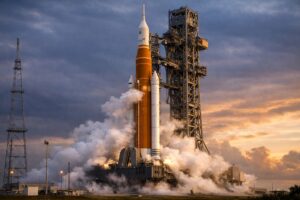
Fueling Test Confirms NASA Artemis Rocket Launch Readiness
The recent fueling demonstration tested one of the most technically demanding elements of any nasa artemis rocket launch — loading super-cooled liquid hydrogen and liquid oxygen into the Space Launch System rocket. This rehearsal simulated actual launch-day operations, allowing engineers to evaluate hardware performance, timing precision, pressure stability, and emergency response protocols.
Fueling a rocket of this scale is not simply about filling tanks. The nasa artemis rocket launch depends on carefully controlled temperature management and coordination between ground systems and onboard sensors. Even minor deviations can trigger automatic safety holds. During the test, teams monitored thousands of data points in real time to ensure the rocket responded exactly as designed.
Officials described the process as smooth and efficient, indicating that prior technical issues encountered in earlier campaigns have been resolved. That progress significantly strengthens confidence that the next nasa artemis rocket launch is on solid footing.
Why This NASA Artemis Rocket Launch Matters
The upcoming nasa artemis rocket launch will send four astronauts aboard the Orion spacecraft on a mission around the Moon — the first crewed lunar mission in more than five decades. While Artemis 1 demonstrated that the SLS rocket and Orion capsule could operate safely without a crew, Artemis 2 will validate life-support systems, navigation controls, and human-rated performance standards.
This mission is a pivotal bridge between testing and sustained lunar exploration. A successful nasa artemis rocket launch under Artemis 2 will lay the foundation for Artemis 3, which aims to land astronauts near the Moon’s south pole. The broader Artemis campaign is designed to establish a long-term human presence on the lunar surface and prepare for eventual missions to Mars.
Beyond scientific achievement, the nasa artemis rocket launch represents a strategic milestone for international partnerships and commercial space collaboration. Multiple global space agencies and private industry contractors are contributing to infrastructure that will support future missions.
Inside the Space Launch System Powering the NASA Artemis Rocket Launch
At the heart of the nasa artemis rocket launch is the Space Launch System (SLS), the most powerful rocket ever developed by NASA. The SLS combines core-stage engines derived from the Space Shuttle program with advanced solid rocket boosters and upgraded avionics systems.
The fueling test confirmed that the SLS core stage can safely handle the extreme cryogenic temperatures required for launch. Liquid hydrogen must be stored at approximately minus 423 degrees Fahrenheit, while liquid oxygen remains at minus 297 degrees Fahrenheit. Maintaining structural integrity under such conditions is essential for the success of the nasa artemis rocket launch.
Engineers also verified ground launch systems at Kennedy Space Center, ensuring that fuel transfer lines, valves, and pressure regulators operate seamlessly with rocket hardware. This synchronization is crucial to clearing the vehicle for flight.
Astronaut Readiness and Human Factors
While rocket systems take center stage, the nasa artemis rocket launch is equally about astronaut readiness. The Artemis 2 crew has been undergoing intensive training, including launch simulations, emergency drills, and Orion spacecraft operations.
The fueling test indirectly validates astronaut safety systems, confirming that environmental controls, communications, and abort procedures are integrated correctly. For a crewed nasa artemis rocket launch, redundancy and fail-safe mechanisms are non-negotiable.
NASA has emphasized that Artemis 2 will not land on the Moon but instead conduct a lunar flyby, testing spacecraft systems in deep space conditions before committing to surface operations in later missions.
Technical Lessons Applied to the NASA Artemis Rocket Launch
The Artemis program has incorporated lessons from Artemis 1 and previous launch delays. Earlier attempts revealed issues such as hydrogen leaks and sensor inconsistencies. Engineers implemented design adjustments and procedural refinements to strengthen system reliability ahead of the next nasa artemis rocket launch.
The successful fueling rehearsal demonstrates that these corrective actions are working. Continuous testing and incremental validation are central to NASA’s safety-first approach. Each milestone completed reduces uncertainty and increases launch probability.
By methodically addressing technical challenges, NASA is ensuring that the nasa artemis rocket launch maintains the highest standards of operational safety.
Global and Scientific Impact
The nasa artemis rocket launch carries implications beyond national prestige. Scientific instruments aboard Orion will gather data on radiation exposure, deep-space navigation accuracy, and lunar orbital dynamics. These insights will shape mission planning for future surface expeditions.
International partners are also preparing modules for a future lunar Gateway station, which will orbit the Moon and serve as a staging point for exploration. The upcoming nasa artemis rocket launch represents a foundational step toward building that infrastructure.
In addition, the Artemis campaign is inspiring a new generation of scientists, engineers, and students. Educational institutions are incorporating mission data into STEM programs, further expanding the societal impact of the nasa artemis rocket launch initiative.
Timeline Toward Launch
With the fueling test completed successfully, final preparations now focus on data review, system inspections, and final launch authorization processes. NASA’s launch teams will conduct additional readiness checks before confirming the exact date of the nasa artemis rocket launch.
Weather conditions, technical clearances, and safety approvals will all factor into final scheduling decisions. If timelines remain stable, March could witness a historic moment as astronauts embark on humanity’s next journey around the Moon.
The Road Ahead
The Artemis program marks a turning point in space exploration strategy. Unlike the Apollo era, which focused on short-term lunar visits, the nasa artemis rocket launch series aims to build sustainable capabilities. Infrastructure, partnerships, and technology development are all designed for long-term presence rather than symbolic achievement.
The recent fueling test underscores that NASA is methodically transforming ambition into action. Each validated system, each rehearsal, and each review session brings the next nasa artemis rocket launch closer to liftoff.
As anticipation builds worldwide, one thing is clear: the journey back to the Moon is no longer distant speculation. The successful test proves that the upcoming nasa artemis rocket launch stands on a foundation of rigorous engineering, strategic planning, and renewed human determination to explore deep space.

Rakesh is a digital publisher and SEO-focused tech writer covering technology trends, blogging strategies, affiliate marketing, and trending news. With expertise in search optimization and online growth, he delivers research-driven insights, practical guides, and timely news updates. His content focuses on helping readers understand digital trends, emerging technologies, and effective online publishing strategies in a rapidly evolving tech landscape.
Leave a Reply